Your JD is boring
Open any job board right now. Pick a company at random. Click on a role.
Let me take a wild guess. It'll start with a paragraph about the company thats basically a copy paste from the About Us page. Then it'll be a laundry list of role responsibilities & requirements. Maybe some stuff about a fast-paced environment and cross-functional collaboration. It'll end with a benefits section at the bottom - free snacks at the office 👍
Every JD on the internet looks the same.
Once in a while though, I come across JDs which are special. The founder personally wrote it, in their own voice. They talk about the problem statement directly. Why the market opportunity is real. What the company's unfair advantage is. What the mindset of the founding team looks like. Candidates read this JD and can either see themselves flourishing in such a role, or self-select out.
There's no corpospeak whatsoever.
This is the kind of JD your company needs.
Writing a good JD is one of the highest leverage activities a hiring manager or a founder can do.
For starters, stop thinking of it as a Job Description
Calling it a JD dumbs down whatever it is that you want to put out there. A "Job Description" sounds like a bureaucratic document; a description for a job. But what I'm going for here is something closer to a founder making a case to a future teammate about why this work matters.
You need to pitch to potential future team-mates the same way you'd pitch to investors.
Start by open a new google doc and give it the title: Here's why you should join us to build X
Once you frame it this way, you'll think of this document as you making a case for why people should join you in your mission.
You're making a pitch to someone who might spend the next several years of their life working alongside you, on your problem
Repel certain candidates from applying
Let's say you are only looking for highly-competent grinders to join your team. In your JD, you might as well hint to candidates that if they are looking for work life balance or a 9-5 job, that this is probably not a good fit for them.
Explain how your company is at a stage where you need mission focussed people to join. If you have wide open budgets, talk about how you are ready to pay whatever compensation it takes if you find the right candidate.
You want to repel certain candidates from applying in the first place.
One of the better JDs I've seen
One of the better job descriptions I've come across is from the Recurse Center. It's for a facilitator role, and it reads like the founder sat down and wrote you a personal letter about what they're building and why it matters.
It opens by describing their philosophy on education, what they believe about how people learn, and why they built a radically self-directed retreat for programmers. By the time you get to the actual job requirements, you already care (or maybe you didn't relate to the mission statement and you filter yourself out). So you already know whether or not this is your kind of place.
He tells you the downsides of the job: the unglamorous work, the lower-than-market pay. They tell you their team gets in around 10am and leaves around 6:30pm. They tell you they'll share their full cap table and every founder's salary if you get an offer.
On a side note, not every company needs to offer this level of financial transparency, of course. But the transparency in the Recurse Centre JD does inspire trust from the reader, which in turns creates a connection between the reader and the founder. You should find your own angle to create such a connection, even if it isn't this level of radical transparency about financials.
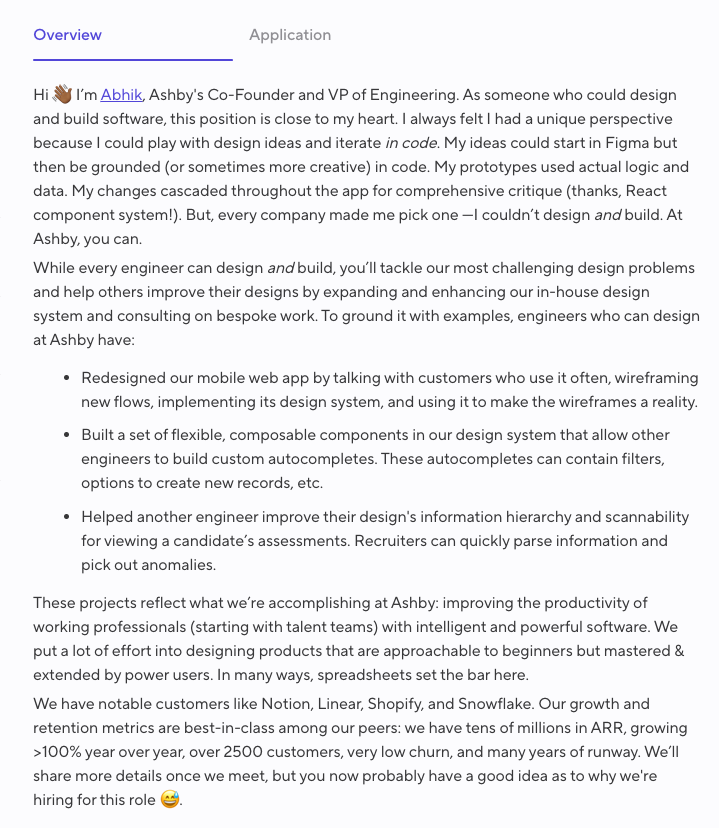
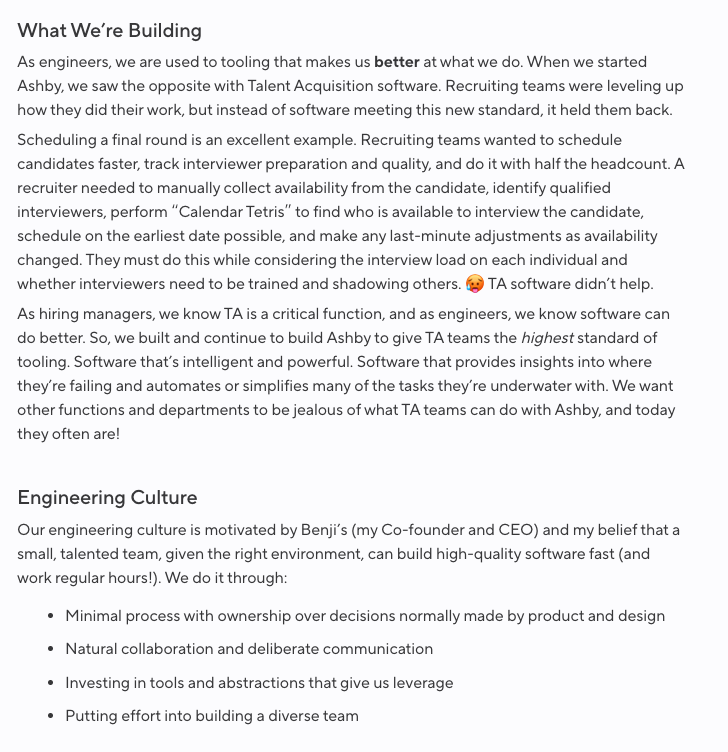
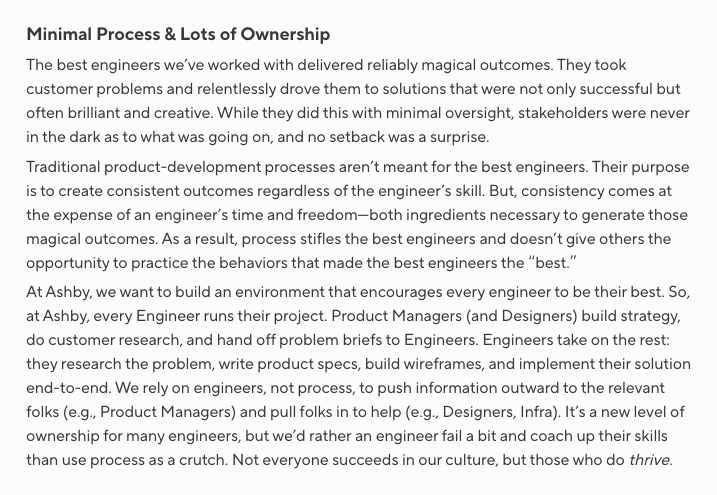
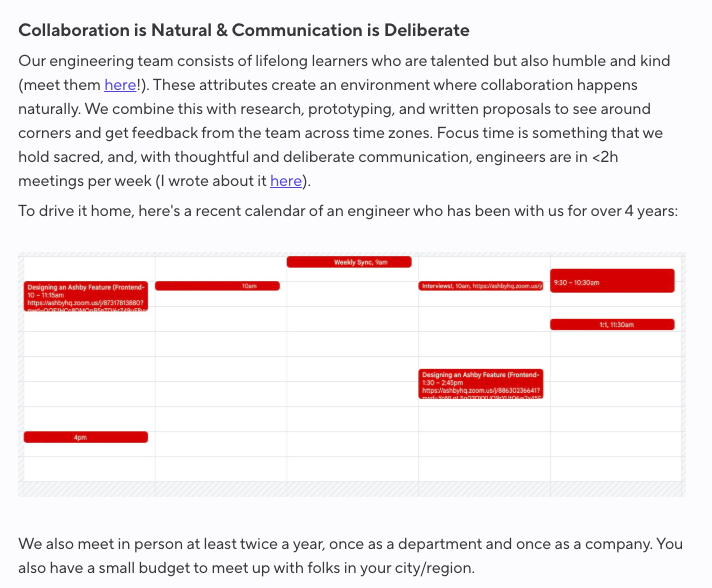
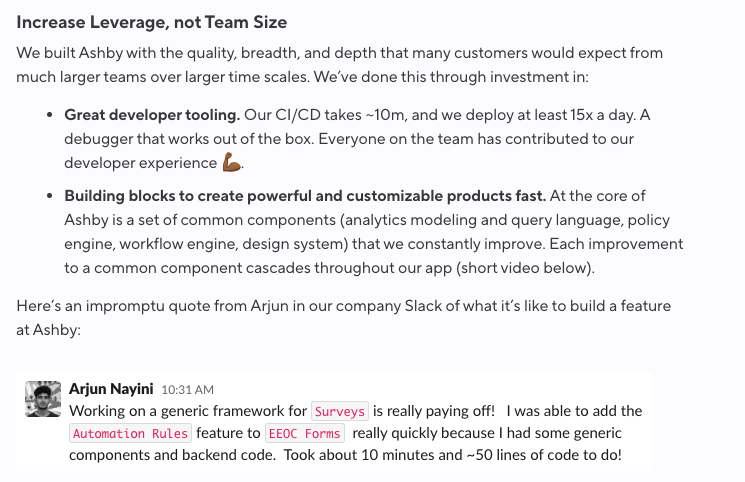
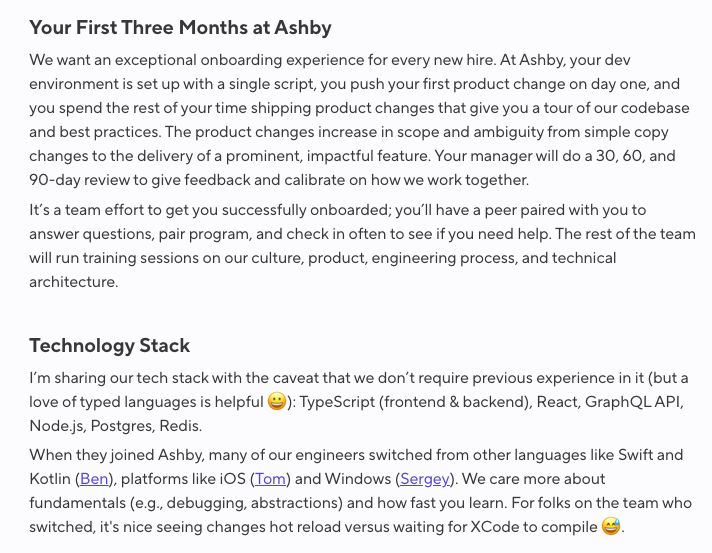
At the end of this post, I link to another JD from Ashby which is just as good as the one above.
Tell candidates what they actually want to know
There's a list i found on Hacker News about what candidates want to know about a company before they apply
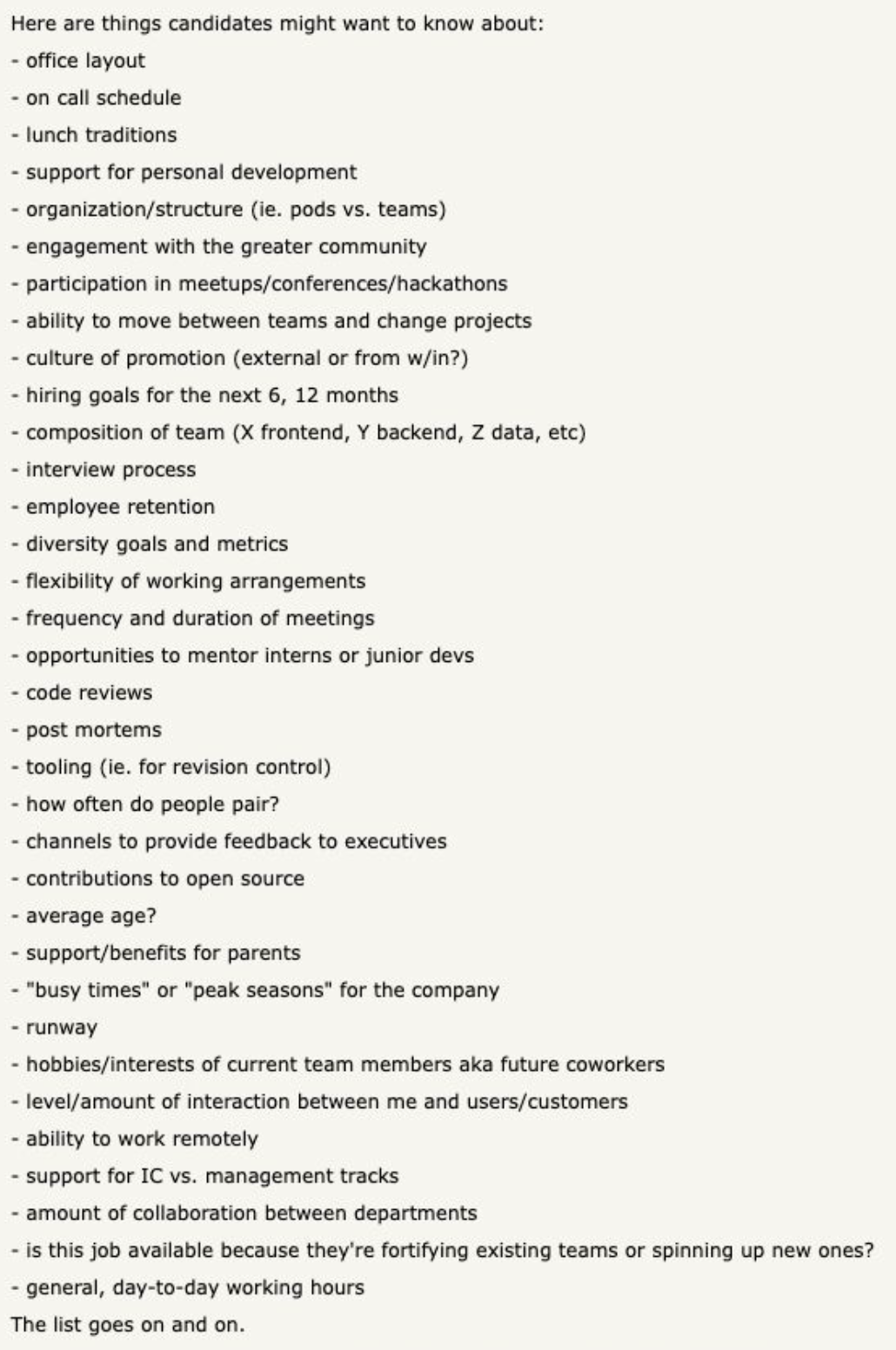
Most job descriptions answer almost none of these questions. They describe the role in abstract terms and expect candidates to figure out the rest during interviews. Btw this means your best candidates, i.e. the ones with the most options, are making decisions with incomplete information and often just moving on.
The Recurse Center JD addresses this. It has a section called "What to expect from our interview process" that walks through every stage, explains the purpose of each round, and commits to getting back to candidates within two business days. It has a "Pros and cons" section that leads with the downsides. It tells you exactly what the team's daily rhythm looks like.
You could structure this as a companion page, a section within the posting, or even a series of short videos from team members (Alex from Morninbrew did this).
This kind of transparency gives you an advantage. When a candidate reads your job description and feels like they already understand what working with you would be like, they are much likely to apply and do their best to interview well.
The "would you apply?" test.
Before hitting publish, read your own JD and ask yourself: if I were a candidate seeing this company for the first time, would I feel anything? Most hiring managers have never actually paused to read their own JD from the candidate's perspective.
The best hire you'll make almost didn't apply. There's a class of exceptional people who are passively open but not actively job-hunting. They're definitely not on job boards. Maybe they see your posting because a friend forwarded it to them. These people will only apply if the writing makes them feel something, which goes back to why story-driven matters more than checkbox-driven.
Use the MSN framework, but keep it internal
There's a useful framework called the MSN list by Shreyas Doshi - Must have, Should have, Nice to have - that forces you to identify the three or fewer attributes that truly matter for a given role.
The rules are simple: max three items in each category, each item must be a single evaluable attribute, and you should be able to assess each one through your interview process or reference checks. Skip the basics like high integrity or strong work ethic that you'd want in any hire. Focus on what's specific to this role.
For example, for a senior PM role, "Must have" might include strong product sense, highly influential communication, and the ability to work well with an empowered engineering team. "Should have" might include domain experience with mobile apps and experience founding or starting things. "Nice to have" might include having worked on a top-50 app.
The key here is that the MSN list is an internal alignment tool. Use it to get clarity yourself or to get your team on the same page about what you're actually looking for. But don't just dump it into the external job description and call it done.
The external posting should take those insights and weave them into a narrative. For e.g. instead of writing "Must have: 5+ years in distributed systems" write about the specific distributed systems challenge your team is facing and why someone with deep experience there would thrive.
Conclusion
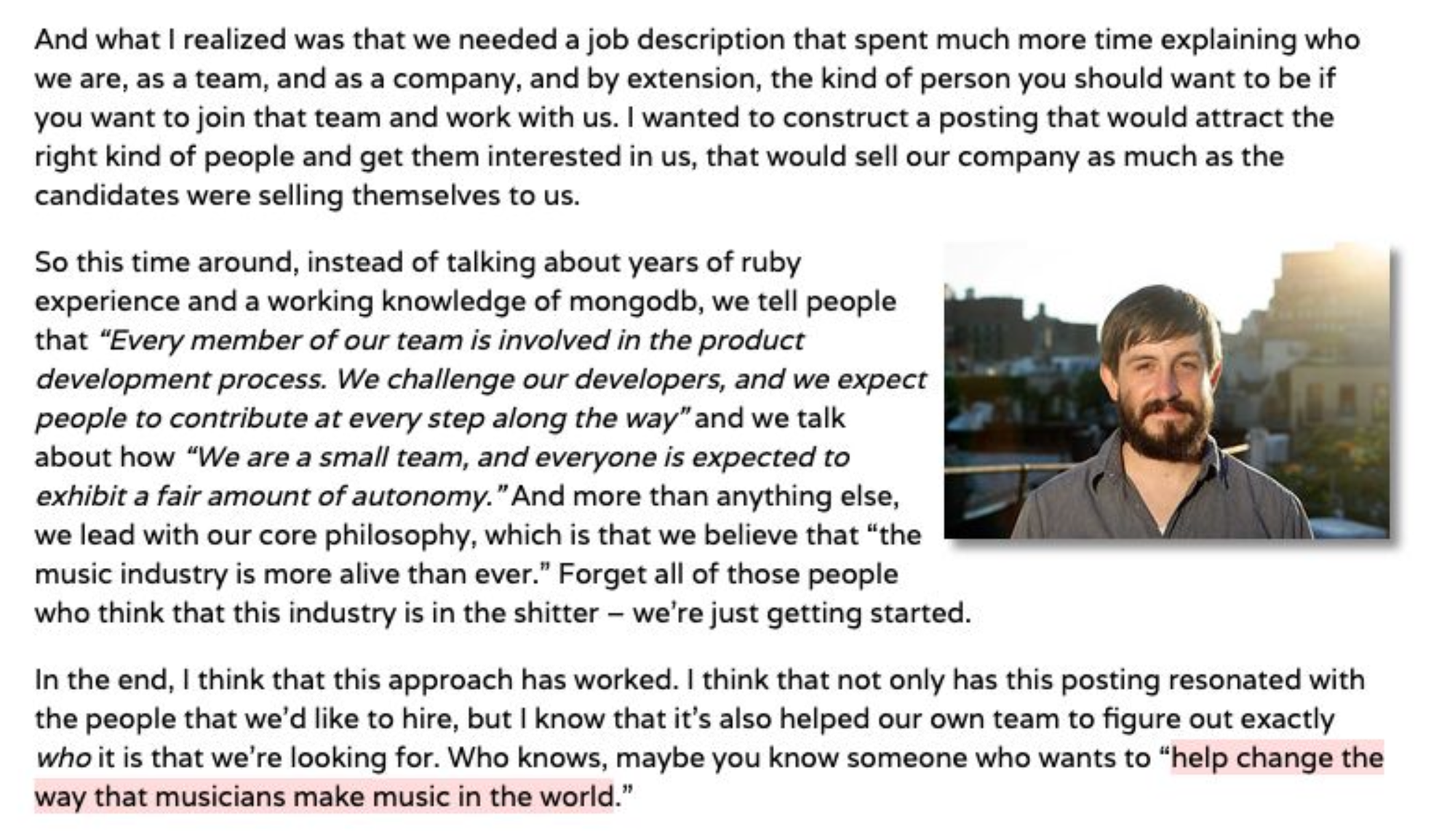
If you want to attract people who care about the problem you're solving, you need to write something that makes them care. Let your personality shine through. This requires thought & effort.
Don't hand the job description to a recruiter or your HR team who writes it in the same corporate voice used by every other company.
Lead with the mission, write in a human voice, be transparent about the tradeoffs, answer the questions candidates are actually asking, and treat the job description as the first real conversation you're having with someone you could be working alongside for the next 10 years.
Appendix: One of the best JDs I've seen
This one is from Ashby. I'm putting the screenshots here directly because who knows when they will remove the job posting from their site.