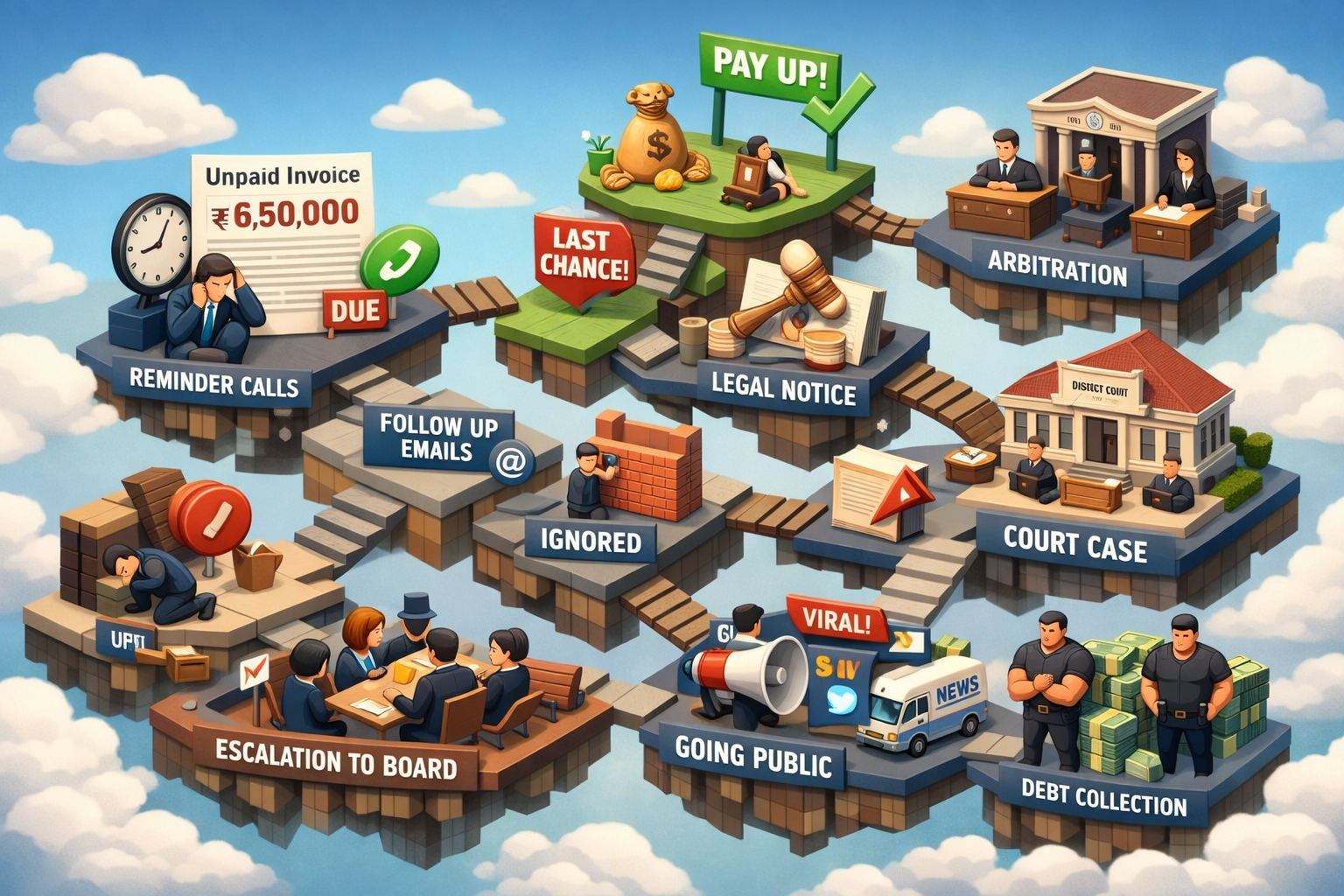
What we do when Indian clients refuse to pay
To collect payments for legitimate work you've done, there are times you need to escalate matters beyond the typical followups.
Background: We're a technical recruitment firm that charges clients when they successfully hire someone from our pool of candidates. We charge after the service is rendered. Our invoice value is roughly between ₹2L - ₹10L in commission.
So a lot of what I speak about in this post keeps the above context in mind. Point being, the nature of payment collections may change when the invoice amount is much larger.
The Reality of Payment Collections in India
Out of the thousands of invoices we've collected from our clients over the course of TopHire's lifetime, I'd roughly break it down as follows:
- 20% pay like clockwork
- 45% pay with 1-2 followups
- 30% pay with 3-7 followups
- 2% require 7+ number of followups
- 2% request for discounts etc. after the work is done
- 1% require extraordinary measures
The first lesson we've had to internalize is that having to follow up for payments is the norm in India. Whether it's about joining meetings on time, or making vendor payments on time, there isn't a culture of sticking to an established timeline. So it just does not matter if the contract says NET30 (this means that the money has to be transferred 30 calendar days from the invoice date), companies will take their own sweet time. You tend to have a lot less leverage especially when your client is much larger than you.
Even for clients that we have good relationships with, where we may personally know the founders or the CEO, we've noticed it still ends up taking time. Which is something we've learnt to accept as part of how the system works. You can't fight it.
The primary source of our headache however is point 6), i.e. cases where we are required to escalate matters significantly because of fraudulent behaviour or outright refusal to pay. If I had to guess, most vendors tend to not have the stomach to fight for what they are rightfully owed, which means they'd cave in and write it off as bad debt. Or sometimes even if they have the stomach for it, they may not know the ideal escalation matrix to follow.
Well, the rest of the post is about the escalation matrix we follow, which may come in handy for you too.
Who Tends to Pull This Stuff?
From what we've noticed + at our invoice range, the kind of companies that tend to indulge in shady behaviour are founder-led and roughly at the 0-200 employees stage. My guess is that when a company has scaled beyond the 200 employee count, the founders/management are less inclined to spend time or energy figuring out how to weasel out of legitimately owed payments. They have bigger fish to fry, and the reputational risk isn't worth it.
The key here is that the payment has to be legitimately owed. If it's a grey area where we feel that the client has some reasonable points too, we'd probably be willing to let it go or find some compromise. But if there is no doubt in our minds that the payment is legitimately owed and that the company is screwing with us, you should see this through to its end.
For starters, have an agreement that protects you
- We put an arbitration clause in every agreement. Online arbitration is cheaper & faster than courts which helps give leverage.
- We add a significant late fee penalty after a grace period. Increasing costs adds leverage. It looks something like this: "If the payment isn't made by the due date, you agree that you owe us ₹500 for every passing day that the invoice remains unpaid and overdue, beyond the due date"
- We add a clause that says the loser of any court action must pay reasonable attorney costs to the winner. This discourages the other party from withholding payment if they know its ultimately not going to cost us money to claim the amount and in fact they'll need to pay for our efforts (plus the late payment fee above)
The Escalation Matrix
Step 0: Start by trying long and hard to follow normal follow up channels
While making sure everything is documented carefully, do the following:
- requesting a formal payment schedule or commitment in writing
- asking if there are any issues with the invoice that are preventing payment
- ask for a meeting (virtual or in-person) to discuss the outstanding payment
- send frequent follow-up emails at regular intervals, with increasingly urgent subject lines
- escalate to the POC's manager or supervisor when initial contact isn't responsive
- request email acknowledgements to verify your emails are being being received and read
- send payment reminders via multiple channels (email, phone, etc)
- ask your POC to connect you with the accounts team
- ask for dates by which the invoice will be cleared
- call the POCs up periodically to confirm that they intend to pay
Step 1: Create a Google Doc with the Timeline of Events
Let's say a month or two passes and you begin to realize they may be trying to screw with you. For me signs such as fully ghosting us across all channels could be a sign of them attempting to screwing us over.
Begin by creating a google doc to document the timeline of events. Keep it as detailed as possible. Dump screenshots of anything relevant: timestamps of communication between the client and yourself, email threads, WhatsApp conversations, contract clauses, invoice copies, delivery proof. If the client has said anything egregious at any point, make a note of it in the Google Doc.
The more detailed the better.
The purpose of this Google doc is not to convince the person who is refusing to pay to actually make the payment, but to convince everyone else that reads this document that the person refusing to pay is being shady. This document becomes your evidence trail and your insurance policy for everything that follows.
Step 2: Convey Your Escalation Matrix to the Offending Client
A lot of the steps beyond this are a drain on resources and time. So even before beginning to escalate, let the offending client know that you aren't planning to back down and that you have a clearly defined process by which you will be escalating matters.
Send them an email that clearly outlines what you will do. Something like:
"We've made multiple attempts to resolve this matter amicably. Since we haven't received payment or a reasonable explanation, we will be proceeding with the following steps:
1. Sending detailed communications to your board of directors, management team, and investors
2. Issuing a legal notice through our advocates
3. Filing a case in the appropriate court
4. [If relevant] Engaging debt collection agencies
5. [If egregious fraud] Communicating the situation to your employee base and professional network
We would prefer to resolve this without these steps. Please confirm payment by [specific date]."
Your escalation matrix should include sending emails to everyone in the board of directors, the management team, investors, etc. Depending on how egregious the client behaves, you'd also want to email employees if it's outright fraud by the management team.
The reason you convey this upfront is simple: many companies will fold at this stage itself. They realize you're serious and methodical and have thought this through. And they'll determine that the reputational damage of you following through isn't worth the amount of money they're trying to save.
Step 3: Send a Legal Notice
If you don't want to engage a law firm (which will be a bit more expensive), reach out to advocates personally and ask if they'd be willing to issue a legal notice on your behalf. It won't cost more than ₹5,000 or so.
The legal notice should be professionally drafted and should include:
- Clear statement of the services rendered
- Invoice details and payment terms
- Timeline of non-payment and follow-ups attempted
- Amount owed with any applicable interest
- Demand for payment within 15 days
- Warning of legal proceedings if payment is not received
Most companies will settle at this stage. A legal notice makes it real for them, it's no longer just an annoying vendor sending emails, it's potential legal liability.
Step 4: Send an MSME non-payment notice
The MSME non-payment notice (under the MSME Development Act, 2006) can be quite useful for recovering payments from Indian clients, but its effectiveness depends on several factors:
How it works:
- If a buyer doesn't pay an MSME supplier within 45 days, the supplier can file a reference with the Micro and Small Enterprises Facilitation Council (MSEFC)
- The council can mediate and pass binding orders
- Unpaid amounts attract compound interest (3 times the bank rate notified by RBI)
- It's meant to be a quicker and cheaper alternative to civil courts
It's useful when:
- Dealing with registered companies or government entities who care about their reputation and compliance
- The amount involved makes legal action worthwhile but not enough for expensive litigation
- You have clear documentation (purchase orders, invoices, delivery proof)
- The client has assets/operations you can eventually enforce against
Step 5: Email the Board, Management, and Investors
If they haven't paid up despite the initial mild escalations, now you actually execute on what you told them you'd do. Use the Google Doc you created in Step 1 as the foundation of your email.
Find the email addresses of:
- All board members (check the company's official filings, LinkedIn, or MCA records)
- C-suite executives
- Investors (most startup investors are listed on Crunchbase or the company's press releases)
Keep the email factual and professional but firm. Subject line should be something like: "Urgent: Outstanding Payment of ₹4.65 Lakhs to TopHire"
In the email:
- Briefly explain who you are and what service you provided
- State the amount owed and how long it's been pending
- Link to your detailed Google Doc
- Mention that you've already sent a legal notice
- Request their intervention to resolve this matter
CC everyone relevant. The point is to create visibility and accountability. Most founders/management don't want their investors or board knowing that they're being shady with vendor payments. If your portfolio company is being shady with vendors, they're likely shady in various other aspects too, so this will spook investors and other stakeholders.
Step 6: Go Public (If Necessary)
We've seen all sorts of cases. Companies that cite cashflows as the reason why they can't pay, but then announce a fundraise two weeks later. Companies that ghost you entirely after years of working together. Companies whose founders block you on WhatsApp and email.
If you've exhausted the above steps and they're still not paying, you need to consider going public. This means:
- Posting about it on LinkedIn with the detailed timeline (tag relevant people if appropriate)
- Sharing in relevant founder/vendor communities
- Leaving reviews on platforms like Glassdoor (mentioning their vendor payment practices)
- Filing consumer complaints or approaching forums
This is the nuclear option and should only be used when you're absolutely certain you're in the right and the company is engaging in outright fraud. But it works.
Step 7: Involve Debt Collection Agencies (For High-Value Amounts)
If the amount to be collected is high (say ₹25L+), it might make sense to engage a debt collection agency. They typically work on a percentage basis (anywhere from 10-30% of the amount recovered).
The advantage here is that they have experience with these situations and can be more persistent than you can afford to be while running your business. They also know the legal system better and can guide you on whether to file a civil suit, approach a recovery tribunal, or use other mechanisms.
The downside is the cost, which is why we only recommend this for larger amounts.
Step 8: File a Case
If none of the above works, you should definitely file a case. For the invoice amounts we typically deal with (₹2L - ₹10L), here are the options:
Arbitration: Remember earlier I said to put an arbitration clause in your agreement? When you enter arbitration, it's basically like going to a private court. Because it's private, it's faster. And it's usually cheaper too because it doesn't carry on for years.
Commercial Courts: Since the Commercial Courts Act was amended in 2018, commercial disputes valued at ₹3 lakhs and above fall under Commercial Courts jurisdiction. These courts are specifically designed to handle business-to-business disputes and are supposed to be faster than regular civil courts.
Summary Suit (Order 37 CPC): This is a faster mechanism for recovering debts where the claim is based on written contracts, bills of exchange, or promissory notes. The advantage is that the defendant has to first obtain leave to defend, which puts the burden on them to show they have a valid defense. If they can't, you get a quick decree.
Regular Civil Suit: If neither of the above apply, you file a regular civil suit in the District Court based on pecuniary jurisdiction.Yes, this is time-consuming. Yes, the courts are slow. But sometimes it's the only way. Once you file a case, the company can't ignore you. They'll have to engage, and often they'll settle out of court because fighting a case is even more expensive for them.
We've gone to court exactly once in our company's history. We "won", as in they settled after the first hearing. The amount they ended up paying us as part of the settlement was more than the original invoice amount. Lol. The key is having your documentation tight (remember that Google Doc from Step 1?) and being willing to see it through.
Bonus: What To Do When They Send A Defamation Notice
Don't back down. Defamation notices usually mean nothing unless the company you are fighting against is massive (public limited company, for example).
When a company sends you a defamation notice after you've escalated, it's usually a last-ditch intimidation tactic. They're hoping you'll get scared and drop the matter. Don't.
Here's what you do:
- Review your documentation: Make sure everything you've said is factual and you have evidence for it. As long as you're stating facts and not making false allegations, you're on solid ground.
- Consult your advocate: Show them the defamation notice. Most advocates will tell you it's hot air if your claims are legitimate.
- Respond through your advocate: Have your advocate send a response stating that all your communications have been factual and that you're well within your rights to pursue legitimate dues. Mention that their defamation notice appears to be an attempt to intimidate you from collecting rightfully owed payments.
- Continue your escalation: Don't let the defamation notice distract you from your goal. Keep pursuing the payment.
In our experience, companies that send defamation notices almost never follow through with an actual defamation case. It's just theater. The moment they realize you're not backing down, they usually fold.
Important Notes
On timing: This entire escalation process can take anywhere from 2 weeks to 6 months depending on how stubborn the client is. Budget your time and resources accordingly.
On picking your battles: Not every delayed payment deserves this level of escalation. We only go this route when:
- The amount is significant enough to matter.
- We're 100% certain we're in the right.
- The client is acting in bad faith (not just slow, but actively trying to avoid payment)
- Some clients, esp. the large companies) are legitimately slow but they are not shady. This is still okay and we don't escalate in such cases.
If you are fighting for legitimately owed dues from your clients that turned out to be shady, reach out to me and I can be your sounding board.